Thursday, March 7, 2013

2013 Aston Martin Rapide S is just an upgraded version


The S after the Rapide name doesn't mean it is a sportier version of the four-door car, but just an improved version, a restyle if you want. Still it does get a bump in power and if you thought that Audi made cars with the bigger "mouths", wait till you see this new Aston Martin with an even bigger one-piece front grille. Already previewed here.

Otherwise the Rapide S did not had any significant changes in appearance besides that front grille, but you still notice its amazing profile and aggressive look if you are lucky enough to be near one.

The all-new Rapide Gen 4 AM11 6.0 liter V12 engine now produces 558hp (410kW) and 620Nm (457lb/ft) of torque. That means the power was increased by 17% from 477hp (351kW) and a smaller but also important increase in torque which stood at 600Nm (442lb/ft).

The 0 to 100km/h (62mph) is reduced by 0.3 seconds dropping from 5.2 seconds to just 4.9 seconds. The top speed increased to over 306km/h (190mph). But besides being more powerful it is also more fuel efficient. The Rapide S now emits 332g/km (the previous version emitted 355g/km) and consumes just 14.2 liters of petrol/gasoline per 100km (19.9mpg UK or 16.6mpg USA).

All of those improvements are justified by Aston Martin by the use of a lighter and hollow cam shafts, dual variable camshaft timing, knock sensing and fully CNC machined combustion chambers.

The chassis of the car is based on the new Gen4 VH architecture and includes the new dynamic stability control (DSC) and the latest Gen4 iteration of Aston Martin’s hi-tech Adaptive Damping System (ADS) that has three modes; ‘Normal’, ‘Sport’ and ‘Track’.

Pictures of the UK-Spec Aston Martin Rapide S.

Wednesday, March 6, 2013

The rebirth of the Alfa Romeo Disco Volante aka Flying Saucer [Video]


The Alfa Romeo Disco Volante also known as the Flying Saucer or the 1900 C52 was a car thas was produced in 1952 and 1953 which had a curious looking body. At that time it was made in collaboration with the Milan based coachbuilder Touring Superleggera, that now has brought to us the modern version of the Disco Volante.

The car was presented at the Geneva Motor Show and it is surely a head turner. Some of the more round shapes of the original car have been replaced by sharper lines that best suit our modern tastes but it still looks classic and classy.

The original Flying Saucer used the 2.0 liter engine with 160hp (118 kW) from the Alfa Romeo 1900 but the modern car uses the chassis, engine and gearbox of the Alfa Romeo 8C. For those who can't remember it's a 4.7 liter V8 that produces 450hp (331kW) and 485Nm (354lb/ft) that is connected to a six–speed semi-automatic transaxle gearbox.

Buy one while you can, production is limited to an undisclosed number of cars.
  
Pictures: autowp

Pininfarina Sergio Concept also had its reveal in Geneva


This concept is named Sergio, after the man who led Pininfarina for 40 years and conceived some of the greatest car legends, the Life Senator Sergio Pininfarina. The future-looking two-seater barchetta has the Ferrari 458 Spider mechanicals and could easily be produced in limited series of a few units.

Chairman Paolo Pininfarina, said that “My father would be proud of this concept car”, “because it expresses the aesthetic values that always inspired him: the purity of the lines, the harmony of form, and balance. Furthermore, he would be happy with this latest concept on Ferrari base, a brand to which we are related by a history that has helped define the most beautiful cars of all time in an evolution that has lasted 60 years and shows no sign of ending".

The design of the car is inspired by the ‘60s Ferraris, including half doors with vertical rotation opening, the headlights inspired by the Dino Berlinetta Speciale 1965, the rear lights reinterpret the circular themes of Pininfarina-Ferrari history and the rear bonnet borrows the iconic round graphic holes of other historical Pininfarina achievements.

Like i said before the car uses the Ferrari 458 Spider mechanicals, so it has the same 4499cc V8 engine with a seven-speed sequential gearbox. Weighs about 1280kg, has a top speed of 320km/h (200mph) and will accelerate from 0 to 100km/h (62mph) in 3.4 seconds.

Tuesday, March 5, 2013

Infiniti Q50 revealed at the Geneva Motor Show


The Q50 is the first car from Infiniti that uses the new Q naming structure and wants to be a serious rival for to all the other top level cars in the premium D-segment. To help achieve that Infiniti made a collaboration agreement with Daimler AG in which the German company would supply the engines to the Japanese company (Infiniti is Nissan's luxury vehicle division).

The entry-level Q50 has a 2.2 liter direct-injection four-cylinder turbocharged diesel engine producing 170hp (125kW) and 400Nm (295lb/ft) connected to a six-speed manual or a seven-speed automatic gearbox. The rear-wheel drive car emits an estimated 112g/km of CO2 while the average fuel consumption sits at just 4.4l/100km (53.5mpg USA or 64.2mpg UK). The top speed of 230km/h (143mph) and the 0 to 100km/h (62mph) time of under 9 seconds means this wont be a slow car.

The other choice available is the Q50 3.5 Hybrid. It uses a 3498cc petrol engine with 302hp (225kW) and 350Nm (258lb/ft), and a 50kW (67hp) electric motor for a combined power output of 364hp (268kW). With this combination you can only have the seven-speed automatic gearbox but you will be able to choose if you it to be all-wheel drive or just rear-wheel drive. Top speed is limited to 250km/h (155mph) while the 0 to 100km/h (62mph) run is done in under 5.5 seconds. The low value of 6.2l/100km (37.9mpg USA or 45.6mpg UK) combined fuel consumption and the also low CO2 emissions of 145g/km are achieved thanks to the hybrid system.

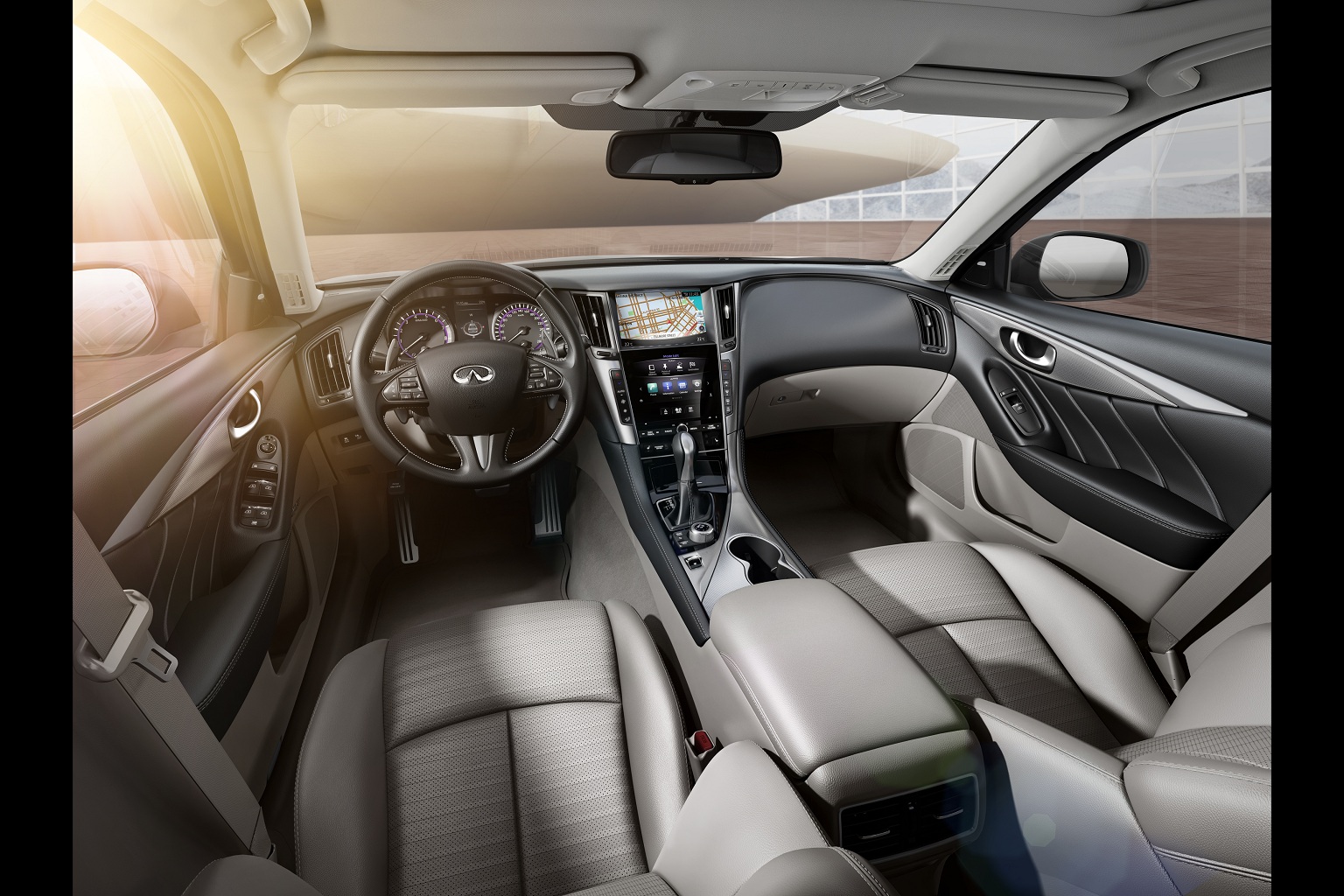
Besides the engines there are other things worth mentioning. It will be one of the first cars ever to use a driver-selectable steering weight and gearing with the world-first Direct Adaptive Steering, dual touch-screens for totally intuitive control and new comfortable seat designed with spinal support inspired by zero gravity research by NASA.

Spyker shows the B6 Venator at the Geneva Motor Show


Spyker, possibly because of the failed attempt to save Saab, was gone from from most auto shows and every time we heard something about the Dutch company it wasn't good news, so it is good to see the car maker is trying to make a return starting with the presentation of the B6 Venator Concept "a unique alternative in the High Luxury Sports sector".

The B6 Venator is a mid-engine luxurious sports car designed to deliver a "rare combination of heritage, design, performance and exclusivity." that includes a timeless piece like the trademark radiator grille’s mesh is V-shaped, referencing Spyker models of the previous century, with modern technology such as the 3D LED rear lights, the aerodynamically shaped glass aircraft canopy and the 19” Turbofan™ wheels.

Like all Spyker the hand-made luxurious interior is made to the higher standards of quality with the finest materials like the leather which is sourced from the Litano range produced by the Royal Hulshof Dutch Tanneries in Lichtenvoorde. It also has the trademark exposed gear change mechanism.

The engine is a mid-mounted V6 that produces over 380hp (280kW) connected to an automatic six-speed gearbox that drives the rear wheels. It weighs less than 1400kg and measures 4347mm length, while it has a width of 1882mm and a wheelbase of 2500mm. It will cost over €100.000.

The Subaru Viziv concept represents a new design direction for the Japanese company


The Japanese car maker says this concept serves as a basis for a new new design direction and to show the new technologies that will be present in future models of the brand. For those that can't remember what i wrote here when Subaru teased this concept, "VIZIV" is a coined word inspired by the phrase "Vision for Innovation".

The powertrain is a plug-in hybrid system combining a 2.0 liter Subaru Boxer diesel engine, a high-torque-compatible Lineartronic (CVT) and three electric motors. We have one electric motor on the front that provides both vehicle drive and power generation and two independent rear electric motors for vehicle drive only.

Those rear motors function mainly in situations of stop-and-go city traffic, allowing for a high torque in low speeds and a lower fuel consumption, while the diesel engine works at higher speeds or to charge the battery.

This concept uses a new all-wheel drive system called the Independent-rear-motor-driven symmetrical AWD due to the two electric motors on the back powering each wheel that act according to the acceleration and steering wheel position.

Here you have it, the La Ferrari. We knew it as the F150, F70 and the Enzo replacement [Video]


This is a little weird, the Italian company decided to call their new supercar, the car we all have been eagerly waiting, La Ferrari or The Ferrari. Are they telling us this is the ultimate Ferrari, the ultimate supercar, the best ever? Well, it is indeed the fastest but it isn't an amazing looking car. If you can see it live at the Geneva Motor Show

But before i make any comments about the look of the car, let's start with the engine and everything that makes the car actually drive. It has a 6.3 liter V12 engine joined by an electric motor for an overall power output of 963hp and over 900Nm (664lb/ft). Both are connected to a seven-speed DCT gearbox that drives the rear wheels.

The V12 engine alone produces 800cv @9000rpm (redline 9250rpm) and 700Nm (516lb/ft) @6750rpm, while the electric motor helps the supercar with 163hp (120kW). CO2 emissions average 330g/km. To power the electric motors there's a lithium-ion battery sourced by Samsung.

Ferrari didn't reveal specific values for the performance, they only said it has a top speed over 350km/h (217mph), will accelerate from standstill to 100km/h (62mph) in under three seconds, to 200km/h (124mph) under seven seconds and will reach 300km/h (186mph) in 15 seconds.

The "La Ferrari" has a length of 4702mm (185.1"), a width of 1992mm (78.4"), a height of 1116mm (43."9) and a wheelbase with 2665mm (104.9") for a weight distribution of 41% in the front and 59% in the rear.

Some of the main features are the new hybrid system (HY-KERS), that has 2 electric motors, one mated to the petrol engine and another used to power auxiliary devices, and a new carbon fiber monocoque that has 27% more torsional rigidity and 22% more beam stiffness in comparison with the Enzo.

Ferrari fitted their new supercar with an active aerodynamics system (front and rear diffusers, guide vane on the underbody and rear spoiler) that generates down-force when needed without compromising the car’s overall drag coefficient.

To help save weight they even made the seat fixed and will be shaped to the owner, but both the pedal box and steering wheel are adjustable. Production is limited to 499 vehicles.

Unfortunately the look of the car isn't that spectacular. It's a Ferrari but there isn't anything really new and fantastic, it has too many details from other models of the Italian company. My guess is it isn't going to age well.